GitHub Code Contribution Guidelines
GitHub Pull Request Guidelines
1. General Principles
This project adopts GitHub Flow as the primary collaboration model. All code changes must be merged into the main branch via Pull Requests (PRs).
Core principles:
- The
main(ormaster) branch must always be deployable - Direct pushes to the official repository’s
mainbranch are not allowed - Each feature or fix must be developed in an independent feature branch
- Each PR should address one clear and focused change
- After a PR is merged, the corresponding feature branch should be deleted
2. Overall Workflow Overview (Corresponding to the Diagram)
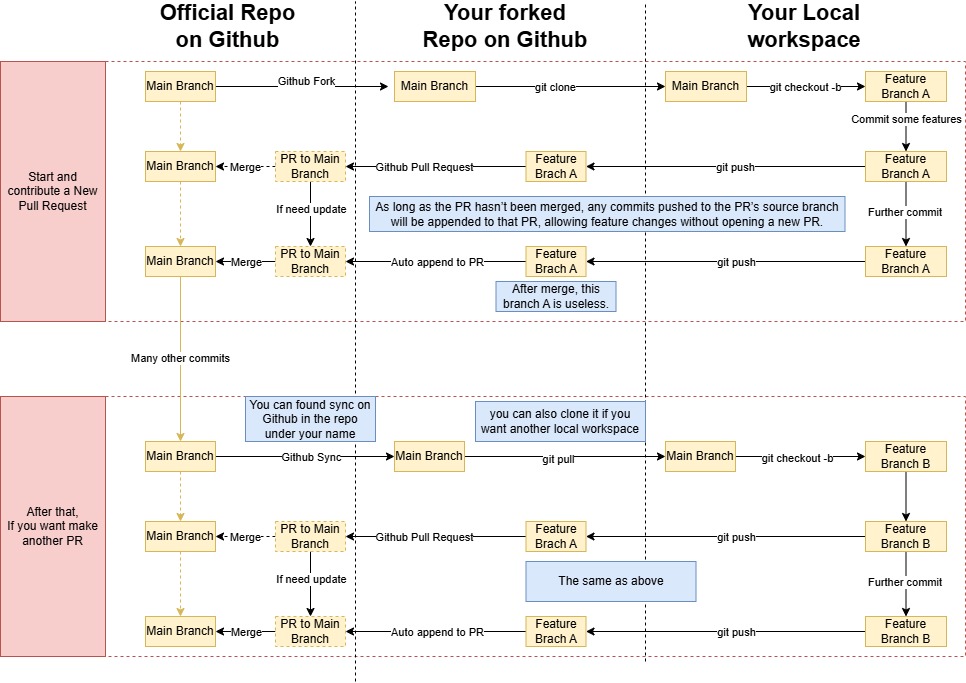
The entire contribution process involves three repositories / environments:
- Official Repository
- Your Forked Repository
- Your Local Workspace
In general, your personal branches and the main repository branch evolve in parallel. For each new feature, you must check out a new branch, implement the feature, and then open a PR. Once the PR is merged, the branch should be abandoned and no longer reused.
3. First-Time Contribution Workflow (Creating Your First PR)
1. Fork the Official Repository
On GitHub:
- Open the official repository page
- Click Fork in the top-right corner
- A forked repository will be created under your account
All subsequent PRs will be created from your fork → the official repository
2. Clone Your Fork Locally
git clone https://github.com/<your-name>/<repo>.git
cd <repo>
By default, you will have:
- A local
mainbranch - A remote named
originpointing to your forked repository
3. Create a Feature Branch from main
Do not develop directly on the main branch
git checkout main
git pull origin main
git checkout -b feature/xxx
Recommended branch naming conventions:
feature/xxx: New featuresfix/xxx: Bug fixesrefactor/xxx: Refactoringdocs/xxx: Documentation changes
4. Develop & Commit Code
git add .
git commit -m "feat: description of xxx feature"
Commit messages are recommended to follow Conventional Commits:
feat:New featuresfix:Bug fixesdocs:Documentationrefactor:Refactoringchore:Maintenance or miscellaneous tasks
5. Push the Branch to Your Fork
git push origin feature/xxx6. Create a Pull Request
On the GitHub page:
- Select your feature branch
- Open a PR targeting the official repository’s main branch
The PR description should include:
- Background / purpose of the change
- Key modifications
- Whether there are any breaking changes
- Related issues (if any)
4. Updating Code During PR Review (Very Important)
As long as the PR has not been merged, do not create a new PR
If further changes are required:
# Stay on the same feature branch
git add .
git commit -m "fix: update based on review feedback"
git push origin feature/xxx
✔ New commits will be automatically appended to the existing PR ✘ Do not create a new PR
5. After the PR Is Merged
1. After Merge Completion
- The official repository’s
mainbranch is updated - Your fork’s
mainbranch will not be updated automatically
At this point:
The feature branch has completed its purpose and can be deleted
git branch -d feature/xxxYou can also click Delete branch directly on the GitHub PR page.
2. Sync the Official main Branch to Your Fork (Recommended)
On GitHub:
- Go to your forked repository
- Click Sync fork (or Update branch)
Or via local commands (recommended for advanced users):
git remote add upstream https://github.com/<official>/<repo>.git
git fetch upstream
git checkout main
git merge upstream/main
git push origin main
6. Subsequent Contributions (Second / Nth PR)
The workflow is exactly the same as the first time:
- Ensure your local
mainbranch is up to date - Create a new feature branch from
main - Develop → push → open PR
- Review → merge → delete branch
❗ Do not reuse feature branches that have already been merged
7. Common Mistakes & Notes
❌ Incorrect practices:
- Developing directly on the
mainbranch - Mixing multiple unrelated changes in one PR
- Reusing a branch after its PR has been merged
- Creating multiple PRs for trivial changes
✅ Recommended practices:
- Make small, incremental commits with focused PRs
- Write clear and descriptive PR descriptions
- Delete branches immediately after merge
- Frequently sync with the official
mainbranch
8. Summary (One Sentence)
Fork the official repository → create a feature branch locally → open a PR → review → merge → delete the branch → sync main